
Stopping the Sorting Line: Why End-of-Line Inspections Are Killing Your Margins
Walk into almost any high-volume fabrication shop or industrial manufacturing facility, and you will see a familiar sight at the end of the production line. A team of inspectors stands over finished components, checking tolerances, reviewing welds, and sorting the good products from the bad. To busy operations managers, this setup feels like a secure safety net. It provides peace of mind that defective products will not reach the client.
However, relying on a post-production sorting line is one of the fastest ways to erode your profit margins. In today's macroeconomic environment, where material costs remain high and labor markets are tight, passive inspection is a financial drain you cannot afford.
The Hidden Cost of the Catch-All Station
To understand why this approach fails, we need to look at it through the lens of Cost of Quality (CoQ). This framework breaks quality costs down into prevention, appraisal, internal failure, and external failure. When you rely heavily on an end-of-line sorting station, you are pouring capital directly into appraisal.
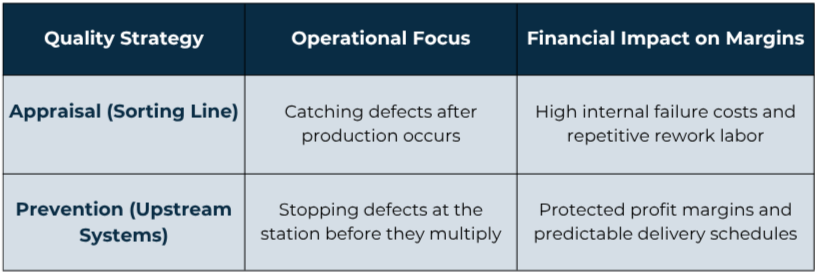
Worse, every time those inspectors find a defective part, you immediately trigger high internal failure costs. Consider a practical example from a structural steel fabrication yard. If an inspector catches a flawed weld after the assembly has already been sandblasted and painted, the fix is incredibly expensive. Workers must scrape away the fresh coating, grind out the defective weld, re-weld the joint, inspect it again, and repaint the entire section.
You have now paid for the labor twice, wasted raw materials, and thrown off your delivery schedule. The sorting line did not solve the defect; it merely documented your waste. True operational efficiency requires moving away from just counting mistakes at the final gate.
Comparing Quality Strategies
Translating ISO 9001 Clause 9.1 into Shop Floor Reality
Many industrial operations maintain these final inspection gates to satisfy formal quality standards, particularly ISO 9001 (International Organization for Standardization). Specifically, Clause 9.1 focuses on monitoring, measurement, analysis, and evaluation. There is a common misunderstanding that having a rigorous final inspection checklist fulfills this requirement.
However, the standard does not ask you to build a passive trap at the very end of your manufacturing process. It requires you to evaluate the performance and effectiveness of your quality management system as a whole.
If your primary data collection consists of a manual tally sheet showing how many parts failed at the final station, you are not truly monitoring process health. You are managing through the rearview mirror. Real compliance means measuring upstream variables, such as tool wear, raw material variances, or welder technique, so you can correct the process before the final product is built.
Shifting Capital to Upstream Prevention
Protecting your margins requires shifting operational capital away from passive appraisal methodologies and into active prevention systems. This change does not require complex theory. It requires practical, field-informed adjustments to your daily workflow.
Implement strict first-off inspections: Do not allow a stamping machine or a CNC (computer numerical control) mill to run hundreds of parts before checking the output. Stop and verify the very first piece against the shop drawings.
Empower station ownership: Give your floor staff the authority to own quality at their individual stations. If a machinist or fabricator notices a variance, they should have the operational power to halt the work and correct the issue immediately, rather than passing a known defect down the line.
Utilize process mapping: Visually lay out your workflows to see where transitions occur. When you map the steps clearly, you can identify the exact areas where errors regularly slip into production, allowing you to add targeted checks where they matter most.
Moving from Catching Defects to Preventing Them
Shifting an entire production team from a "catch it at the end" mindset to a preventive culture takes consistent effort. This is the gap Steelhead often sees on industrial and manufacturing floors. Operations managers genuinely want to build preventive systems, but daily production deadlines and immediate floor fires keep them trapped in a cycle of reactive inspecting.
This is where fractional quality support makes a difference. By embedding an experienced, field-informed quality partner into your operation, you can systematically map out processes, train your floor staff, and realign your operational metrics without adding permanent corporate overhead. This is how Steelhead helps teams move from theory to execution, transforming quality from a costly bottleneck into a reliable protector of your shop's bottom line.
